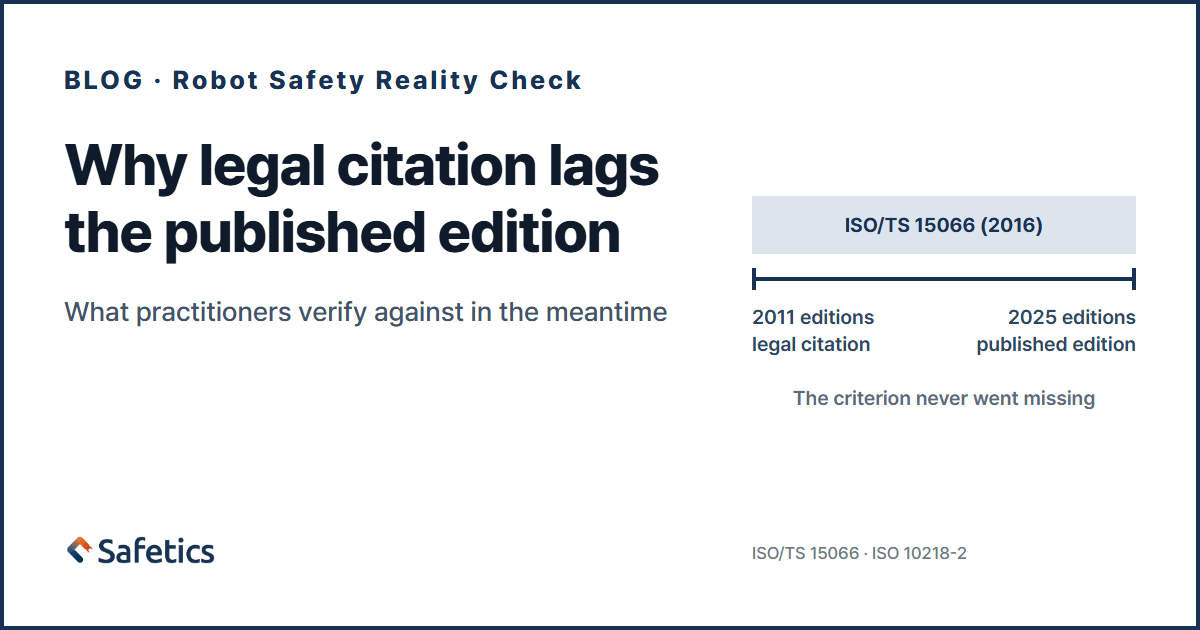
Look up the edition your own market legally cites and you will often find a number older than the one on the standard you just read about. It is tempting to read that as "we are behind." The practical judgement parts company from that reading right there. A standard edition and the criteria practitioners work to are two different clocks, and they have never run at the same speed.
Why does legal citation lag the published edition?
Because publication is an engineering event and citation is an administrative one, and this revision made the administrative side heavier. The 2025 revision was extensive by the publisher's own account — an update that made requirements far more explicit, with industry counts putting Part 2 at roughly three times its previous length (per industry commentary). The wider the revision, the heavier every national adoption procedure becomes. That is the condition of every market updating an edition, not the situation of any one of them.
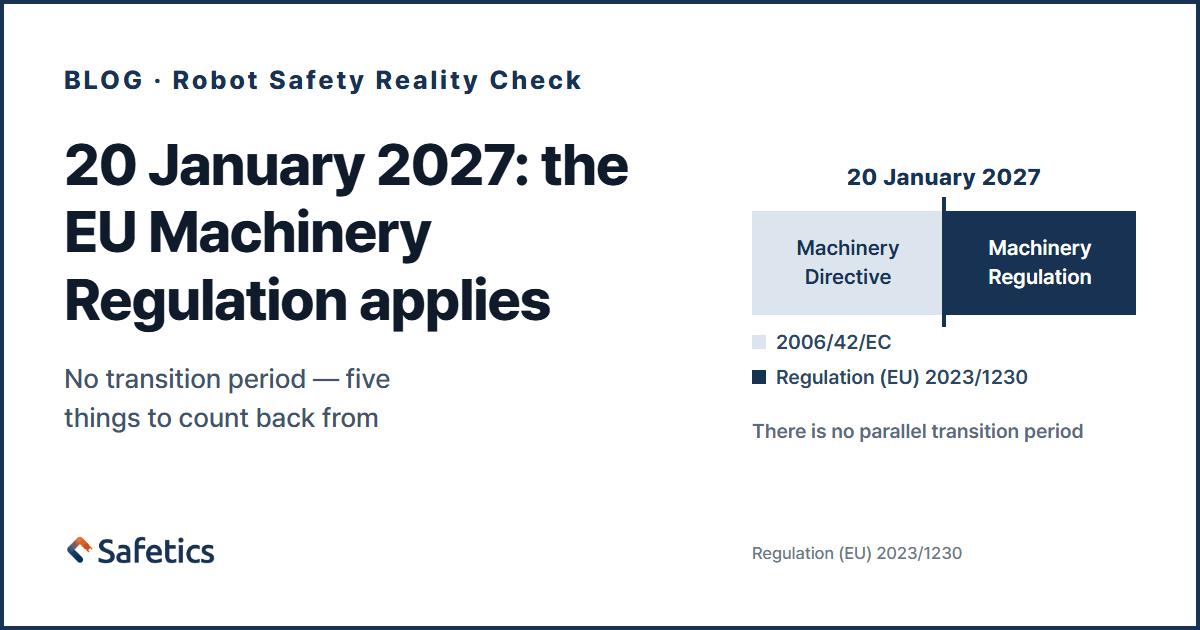
The mechanisms differ, which is why the lag differs. The United States completed national adoption six to eight months after publication. The EU took about nineteen months, citing the 2025 editions on 7 September 2026 — under a Directive that is itself repealed on 20 January 2027, with the Machinery Regulation's own list still to come. Korea's KS B ISO 10218-1 and -2 remain based on the 2011 editions, reaffirmed in 2017 and 2022, with harmonization of the 2025 editions expected to be completed by the end of 2026. The detail of the EU side is covered in 20 January 2027: the EU Machinery Regulation applies.
Is the lag one market's problem, or the general condition?
The general condition — and it matters because the wrong reading produces the wrong plan. A market whose citation lags is not a market operating without a criterion.
Korea is a useful worked example here, because its procedures show what "operating without the new edition" actually looks like. Its occupational safety rules start from a safeguarding-first principle, and the implementing public notice provides a recognized alternative to physical barriers — permission to operate without them — whose requirements are safeguarding measures compliant with ISO 10218-2 together with a documented risk assessment. The audit criterion for Korea's certification of collaborative robot installation sites is KS B ISO 10218-2 itself.
So in that market ISO 10218 is not a reference work. It is the document certification procedures actually read. What harmonization changes is which edition that document carries — not whether the procedures run on it. Read your own market the same way before concluding that a lagging citation means a missing criterion.
What have practitioners used as the contact criterion during the lag?
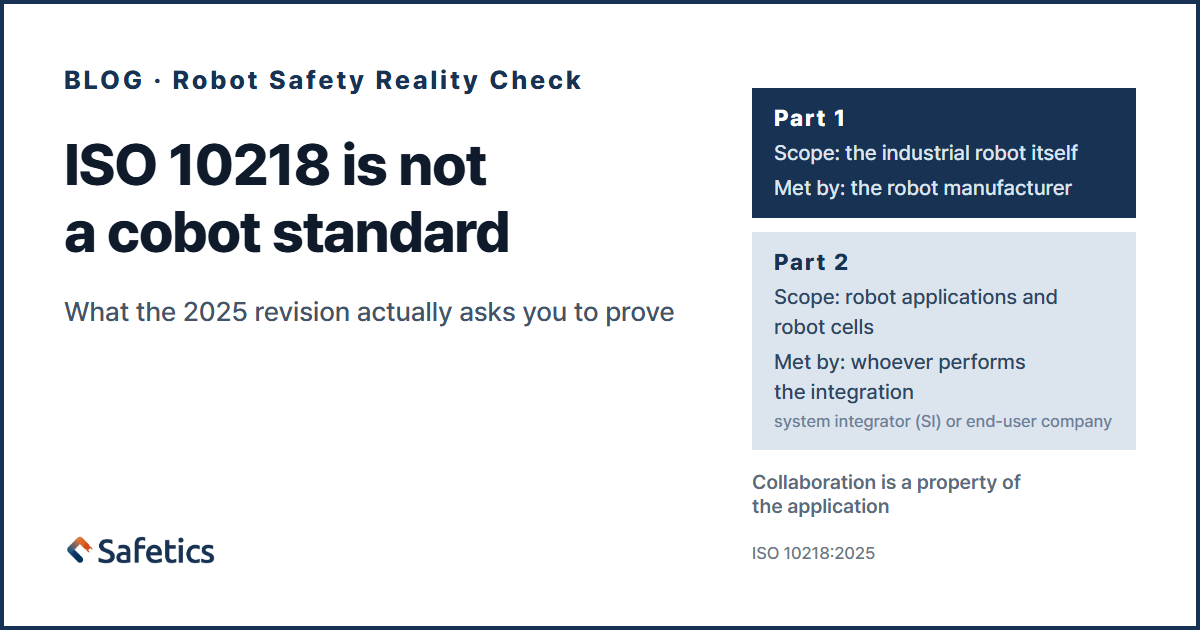
The figures were never inside the 2011 editions to begin with. Those editions laid down the conceptual frame of collaborative operation; the quantified permissible-contact values arrived separately, in ISO/TS 15066 (2016), and stayed in that separate document until the 2025 revision folded them into the main standards. So the criterion never went missing during the interval — it lived somewhere other than where you would look for it now. The United States formalized that arrangement, adopting the specification as a technical report (R15.606-2016).
That is the general answer, and it disposes of the idea that a lagging citation leaves a market without a criterion. What it does not settle is whether the arrangement carries a judgement all the way through to an approval. Korea is worth looking at on that point, because there the values were supplied under two names and the pair makes the mechanics visible. Both look at the same indicator — force and pressure by body region. What separates them is where the permissible value is set.
| KS B ISO/TS 15066 | KOROS 1162-1 | |
|---|---|---|
| Type of standard | National standard (KS) | Industry-association standard |
| Basis of the values | Pain-onset | Pain-tolerance |
Where the two diverge — the indicator is the same, only the line at which the value is set differs.
The first is Korea's adoption of that same international specification, tracing from the Mainz pain research into ISO/TS 15066 and, in 2025, into the main standards. The second is an association standard held in Korea, set so that safety and productivity can both stand. Names and lines differ; the root is the same body of pain research.
What the pair adds is the step after the figures. A table of permissible values does not decide anything on its own — somebody still has to say whether a given application passes. We express that as a single number: whether actual contact satisfies the force and pressure limits the standard gives per body region. That number is the Collision Risk Index (CRI), and at or below 1 it passes. It is what turns permissible values into a judgement a procedure can accept.
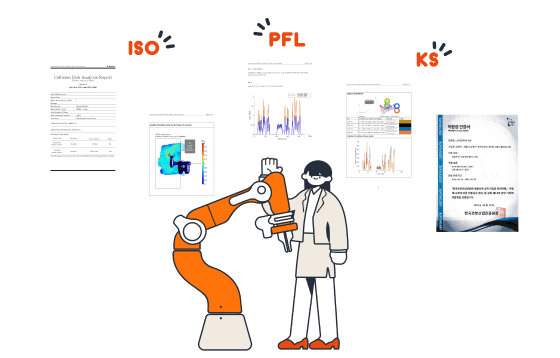
A worked case. A small manufacturer in Korea introduced a collaborative robot into a palletizing process in 2024. The site ran the application collaboratively on Power and Force Limiting (PFL) alone — no physical barriers, no Speed and Separation Monitoring (SSM). In a configuration like that, proving in numbers that contact stays within permissible limits is the entire condition of the thing standing up. The Collision Risk Index came back in the 0.9 range, satisfying the criterion of 1 or below. On that verification the site obtained certification for its collaborative robot installation site, and it could use a collaborative robot in a tight footprint.
That judgement was made while the national standard was still based on the 2011 editions. Nothing was deferred for want of a number to judge against, and nothing had to be invented either — the values came from the same body of research the 2025 editions now carry. The interval was workable. It just had to be worked.
What changes when adoption completes?
The starting point of the work does not move. The name of the document you cite changes; what you have to prove carries straight through. Once harmonization completes, the document a procedure treats as its audit criterion points to the updated edition.
What does change is how specific the requirements are. Because this revision made requirements far more explicit, an adopted edition carries correspondingly more concrete requirements and verification items. Referring to permissible-contact figures inside the same document, rather than fetching them from a separate technical specification, is one result of that.
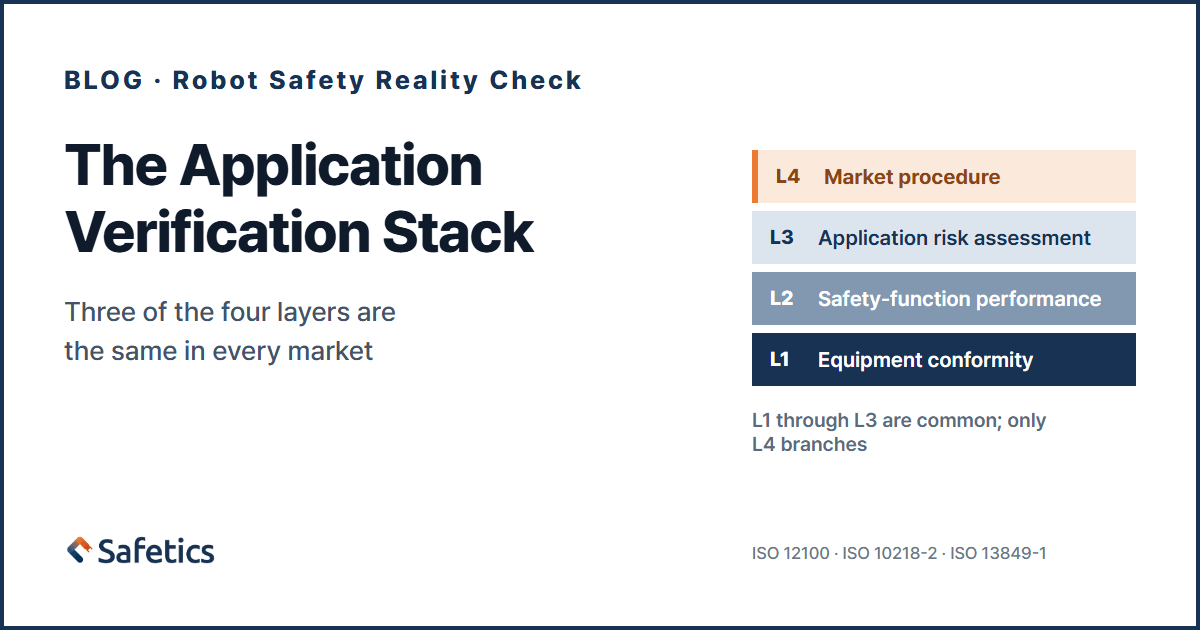
So the thing to do now is not to wait but to label. Mark your existing verification records with the edition and clause of the underlying standard and the same records carry over after adoption. What adoption changes is the name of the document you cite, not the content you have to prove. How each of the three markets asks for that evidence is set out as a layered structure in the 2027 Standards Convergence Report.
💡 Safetics View
Adoption of a new edition is not a starting line. It is the next leg.
The interval was never empty. The permissible-contact figures kept being supplied, judgements kept being made against them, and sites have already carried those judgements through to certification. A plan that begins after adoption completes therefore does not hold together — the verification record you build now is the supporting evidence you will cite afterwards, and the only thing that changes in between is the edition of the document you cite.
The question worth asking is not when the standard in your market will be updated. It is whether you are already proving the numbers it will ask for.
Three markets ask for the same technical evidence in three different procedures. The full report sets out what each one requires, and how far the evidence is shared.













.jpg&w=3840&q=100)










.jpg&w=3840&q=100)
.png&w=3840&q=100)

.jpg&w=3840&q=100)