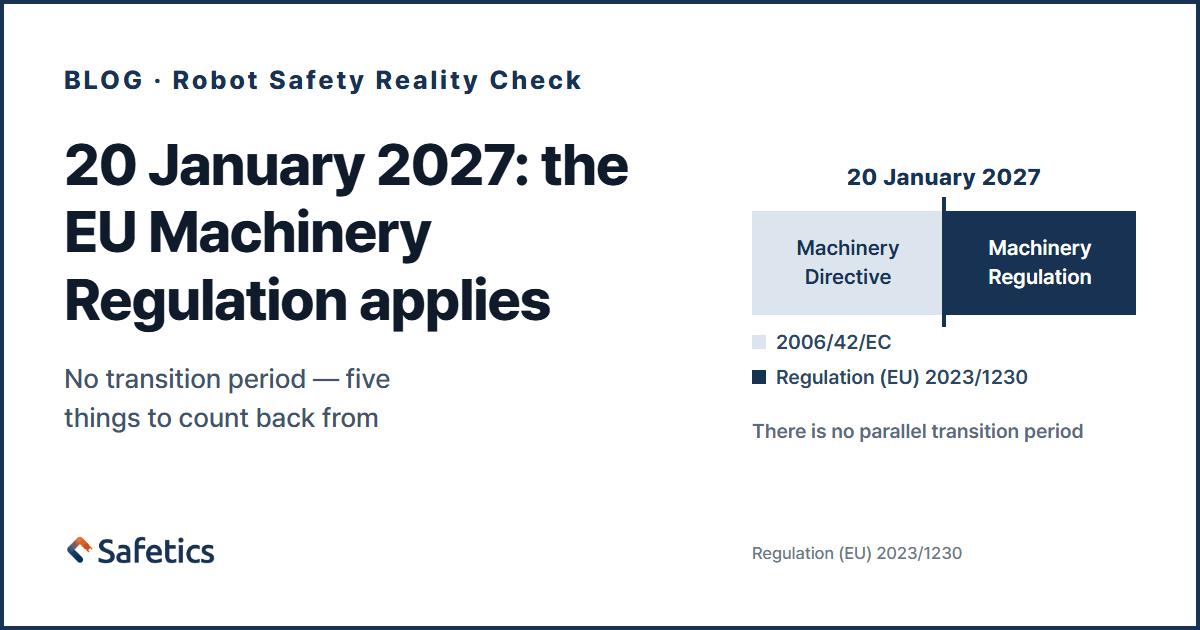
20 January 2027 is not simply a date on which a law takes effect. From that day a new Machinery Regulation applies in the EU, and there is no transition period in which the previous law runs alongside it. So the question that matters is not when the law changes, but from when you have to count your preparation backwards.
What changes on 20 January 2027?
The form of the law changes. The EU Machinery Regulation (Regulation (EU) 2023/1230) replaces the Machinery Directive (2006/42/EC), in place since 2006. It entered into force on 19 July 2023 and applies from 20 January 2027; a few provisions, such as the designation of conformity assessment bodies, applied earlier.
It is worth being precise about who carries the obligation. The Regulation's duties fall on whoever places machinery on the EU market — legally, the "manufacturer" of the final machinery. Often that is a system integrator (SI) delivering an integrated robot cell. Where an end-user company integrates on its own and operates the result at its own site, the obligation is the end-user company's. Conformity assessment and the EU declaration of conformity both flow from that status.
Look at what does not change, too. The Regulation did not bring a new technical criterion for robot safety with it. The Regulation defines what has to be satisfied; ISO 10218 defines how you demonstrate it. The link between them is the harmonized-standards mechanism: design to a harmonized standard and you obtain a presumption of conformity with the Regulation's essential requirements.
One boundary deserves respect. The Machinery Regulation is not equivalent to ISO 10218. It carries requirements that lie outside the reach of robot safety standards — cybersecurity among them. The convergence this article deals with is confined to the layer of robot-application safety verification.
What does "no parallel transition period" mean in practice?
It means there is no buffer in which a state of readiness built for the previous law continues to be accepted for a while. Until 19 January 2027 the Directive alone applies; from the 20th, the Regulation alone.
So your baseline is not the paperwork assembled in the Directive era. It is the technical evidence the Regulation requires. Transcribing documents is short work; producing evidence is not. That is especially true for anything that has to be measured and judged — a configuration that permits human contact, for one.
There is a second consequence worth drawing out. Because the Regulation states what has to be met and the standard states how to demonstrate it, verification built against ISO 10218 does not expire when the law underneath it changes. What changes is the wrapper the evidence is filed in. Which means the same date lands on two companies very differently: one that already holds ISO-grade verification records faces a re-filing exercise on 20 January 2027, and one that does not faces an engineering programme on that same date, with no buffer behind it.
Now that the 2025 editions are cited, what do you prepare against?
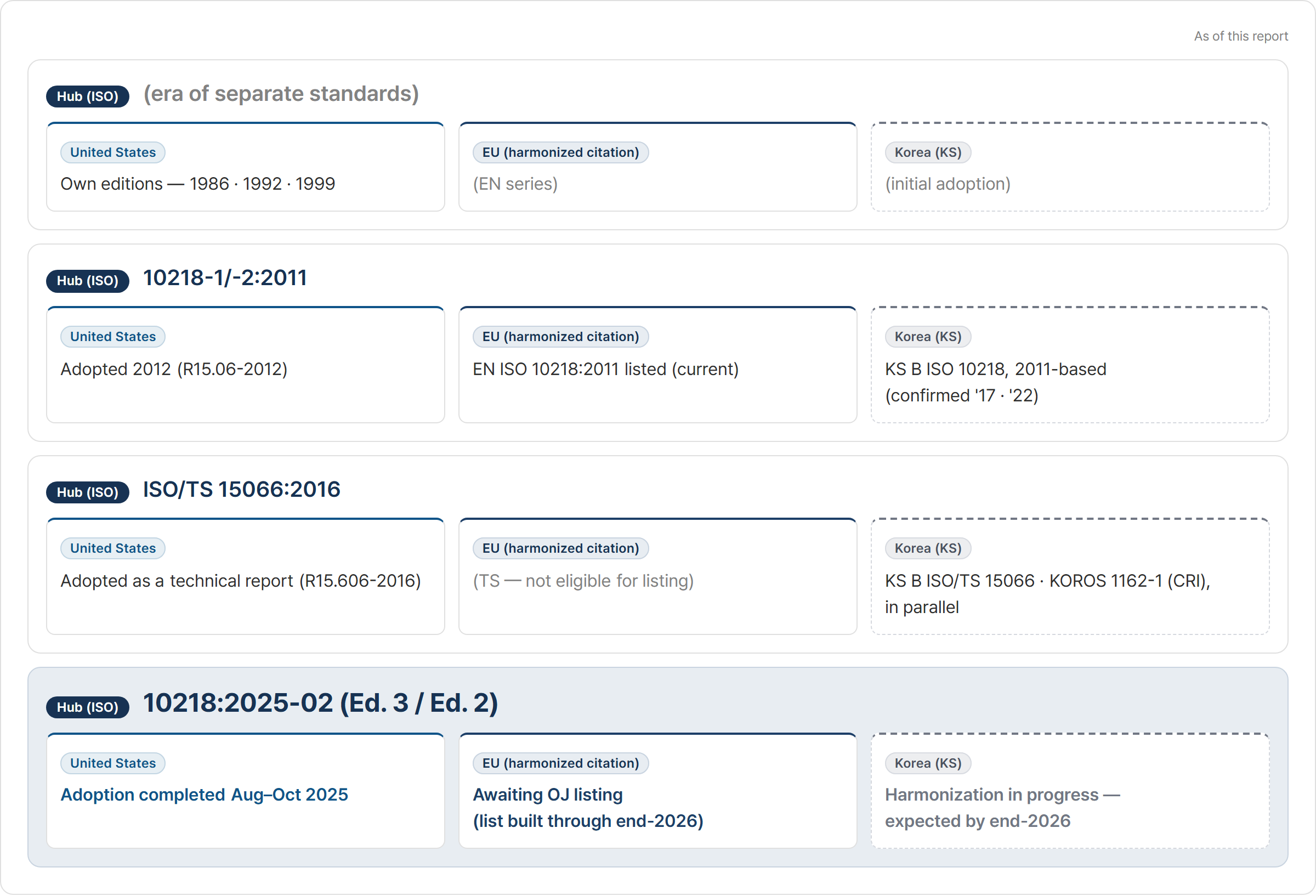
Prepare against the current edition of the standard — which the EU now cites. On 7 September 2026 the Commission published Implementing Decision (EU) 2026/2015, inserting EN ISO 10218-1:2025 and EN ISO 10218-2:2025 into the harmonized-standards list under the Machinery Directive. Presumption of conformity runs from the date the reference is published, and no restriction is attached to either entry. The same decision repeals that list with effect from 20 January 2027, the day the Directive gives way to the Regulation. The Regulation's own list has not been published yet; the Commission says it is in preparation, that it will carry over the vast majority of the standards cited today, and that it can be expected before the end of 2026.
Reading a citation as the finish line is the mistake. Listing is an administrative schedule; 20 January 2027 is a statutory deadline already fixed. The reference arrived about four months before the law it sits under expires, and nothing you have not built by then gets easier when the Regulation's list appears.
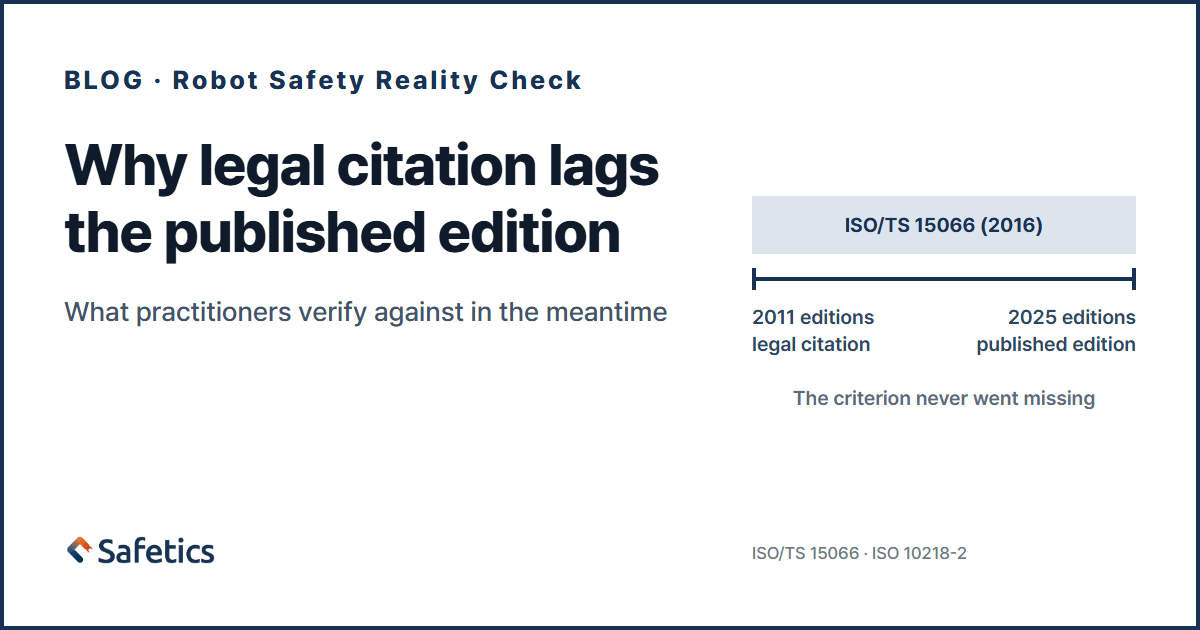
Nor was the lag an EU peculiarity. The United States completed national adoption six to eight months after publication; the EU took about nineteen months to cite the same editions. Where Korea stands, and what practitioners verified against during the interval, is covered separately in Why legal citation lags the published edition.
What should you count back from now?
Start by confirming which markets regulate you and who the responsible party is in each. The body of the preparation is not market-specific paperwork but ISO-grade technical evidence, and the order runs to five steps.
| Step | What you do | Why it comes here |
|---|---|---|
| 1. Confirm exposure and your role | List where you are regulated — EU market placement, supply into the US, overseas sites, domestic installations — and confirm which responsible party you are in each market | If your role is the end-user company's, you can move verification and certification requirements into your terms of supply |
| 2. Inventory by application | Count applications, not robots | Ten robots of one model are separate cases if the applications differ; identical applications reuse the evidence |
| 3. Align the evidence to ISO | Mark existing verification records with the edition and clause of the underlying standard | Market submissions are derivatives of ISO-grade evidence |
| 4. Secure the numbers for contact-permitting configurations | Obtain the proof that contact stays within permissible limits now | It is the hardest evidence to produce retroactively |
| 5. Work backward from 20 January 2027 | If you plan to supply the EU market, plan backwards from this date | There is no parallel transition period |
Five steps for a company preparing to supply — beginning with exposure, ending with the countdown.
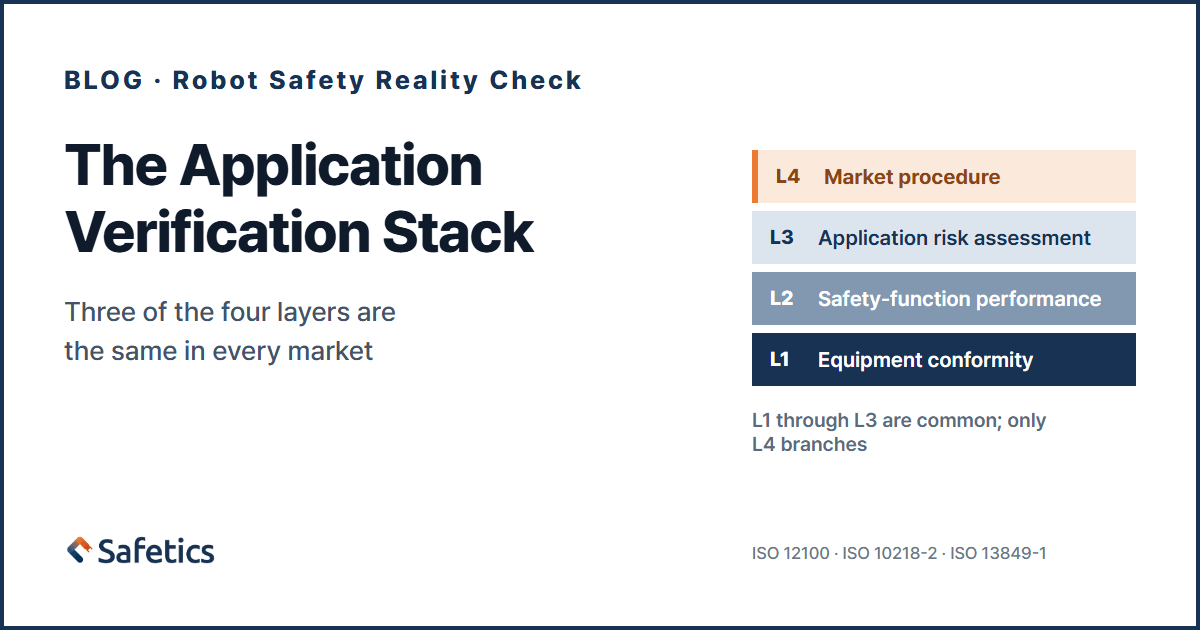
The step that takes longest in practice is securing verification evidence that meets ISO criteria. Among the five, steps 3 and 4 are the bottleneck for the whole schedule. What each of the three markets asks for, and how far the requirements are shared, is set out as a layered structure in the 2027 Standards Convergence Report.
💡 Safetics View
The gap that remains — a citation that expires before the new law's own list arrives — is not a reprieve but a preparation period. The Regulation's date of application is already fixed, and technical evidence takes longer to produce than procedures take to run. Listings and notices arrive at the speed of administration; evidence is produced only at the speed of engineering.
Regulations will keep differing by market. Collision safety verification, as a body of technical evidence, does not have to. Competitive position will turn less on how fast you can produce market paperwork than on how early you secure technical evidence that several markets can reuse.
Three markets ask for the same technical evidence in three different procedures. The full report sets out what each one requires, and how far the evidence is shared.












.jpg&w=3840&q=100)












.jpg&w=3840&q=100)

.png&w=3840&q=100)

.jpg&w=3840&q=100)