Hearing that three markets have come to point at the same standard, the next question is usually whether one approval now travels to all three. It does not. The procedures are still separate, one per market. What changed is not the procedures but the technical evidence they ask for, which has converged into one.
What differs across the three procedures, and what is the same?
All three procedures differ, and the technical evidence they examine is becoming the same. Two facts survive any reading of that, so take them first.
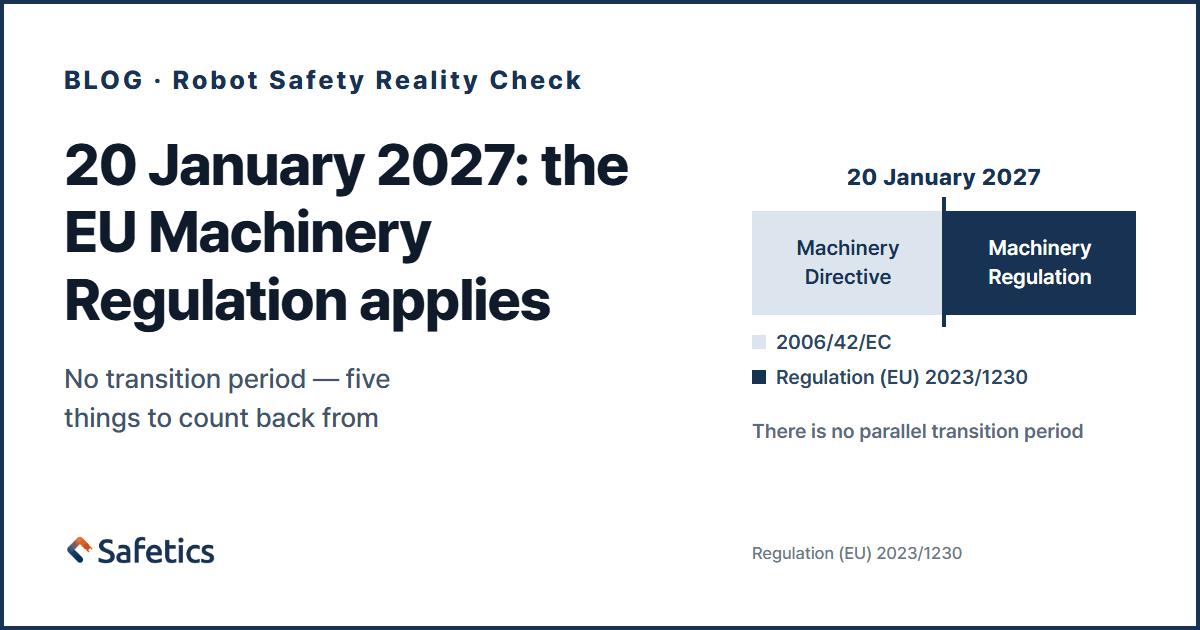
A standard is not, by itself, law. "ISO 10218 becomes mandatory in 2027" is a shorthand. Precisely: from 20 January 2027 the Machinery Regulation applies to whoever places machinery on the EU market, and the revised ISO sits on the practical path to satisfying its requirements. What gives a standard binding force is each market's adoption route.
And requirements converging is not procedures merging. There is no mutual recognition, and the procedures differ in grain as well as in name. The EU requires conformity assessment before placing on the market, together with CE marking. The United States has no prior review procedure; conformance to the national standard is instead the reference point for regulation, contract and liability. Korea does that work through safety certification, self-declaration of conformity, and public notices.
The signatures part company too. In Korea, the legal duty for the application risk assessment rests with the business owner of the end-user company — Article 36 of the Occupational Safety and Health Act places it there. In the EU responsibility sits with the "manufacturer" of the final machinery. The United States codified user requirements in a part of its own, Part 3 of ANSI/A3 R15.06-2025. The evidence converged; the signature did not.
What layers does the Application Verification Stack divide into?
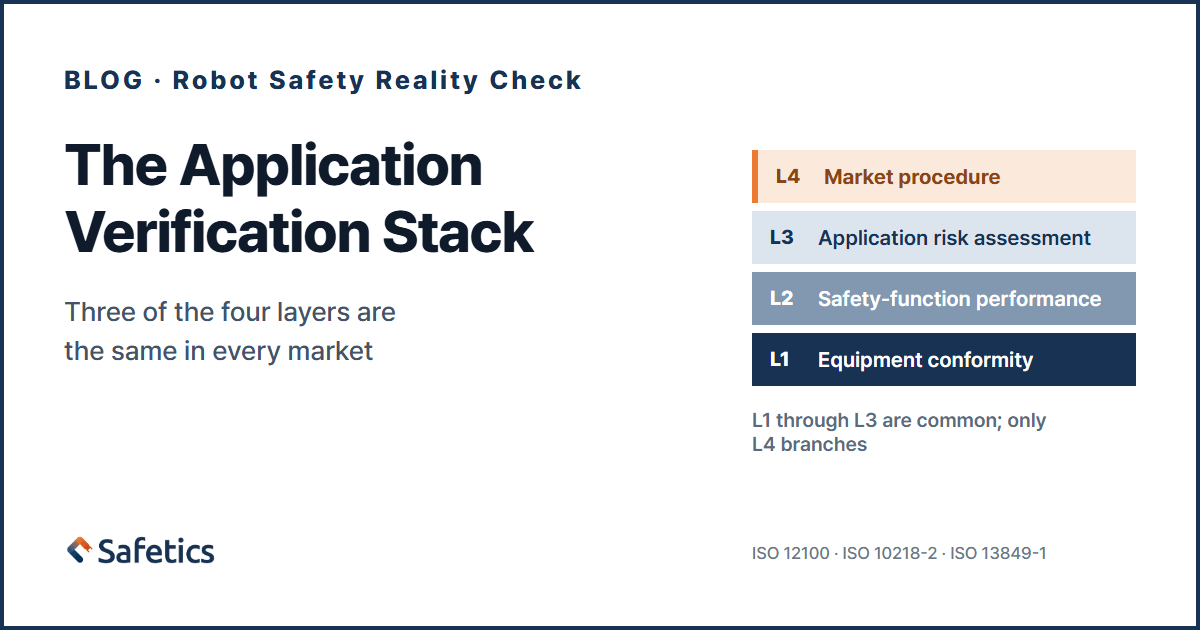
The Application Verification Stack divides the work of proving a robot application safe into four layers. What separates them is what is being verified — the equipment, the safety function, the application, or the procedure.
| Layer | Name | Source of criteria | Common across markets |
|---|---|---|---|
| L1 | Equipment conformity | ISO product standards | Common |
| L2 | Safety-function performance | ISO 13849-1 · ISO 10218 (PL/SIL · verification and validation) | Common |
| L3 | Application risk assessment | ISO 12100 · ISO 10218-2 | Common |
| L4 | Market procedure | Differs by market | Per market |
The Application Verification Stack — L1 is the base, and each layer above it sits closer to the market.
The practical gain from separating the layers is that the unit of preparation becomes visible. How many robots you bought says nothing about readiness. Which layer you hold evidence for says everything.
Which layers are common across markets?
L1 through L3 are common; only L4 branches. Whether the equipment conforms, whether the safety functions deliver the required performance, whether the application risk assessment stands — these are the same three questions in every market that asks them.
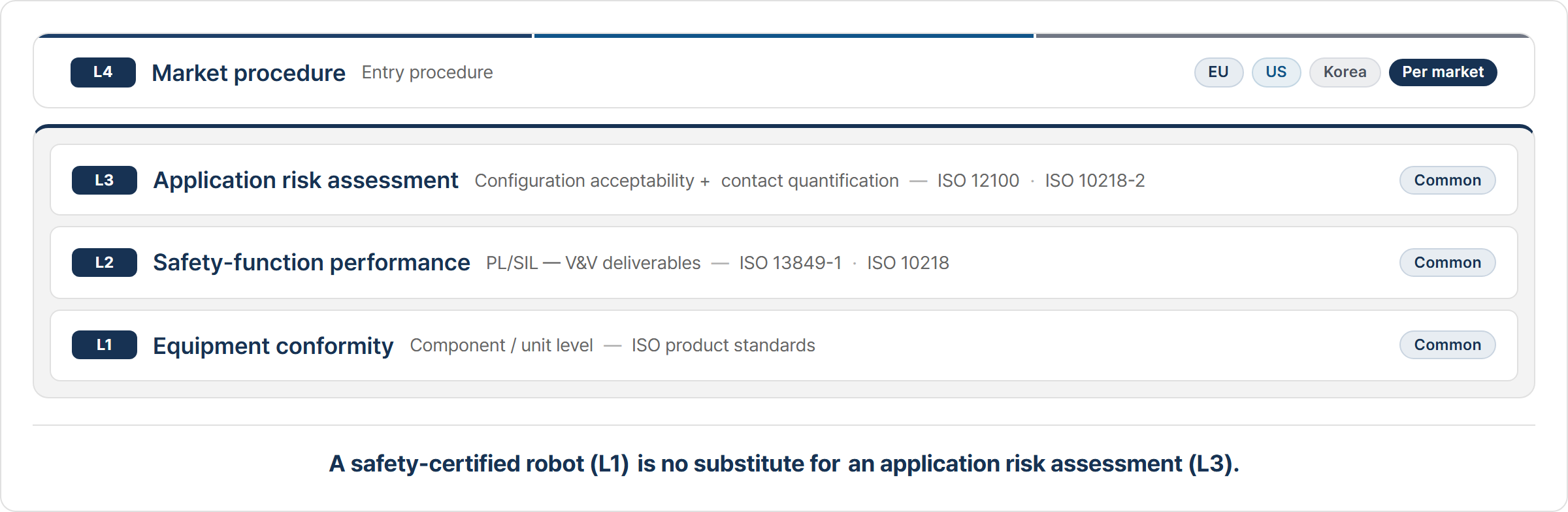
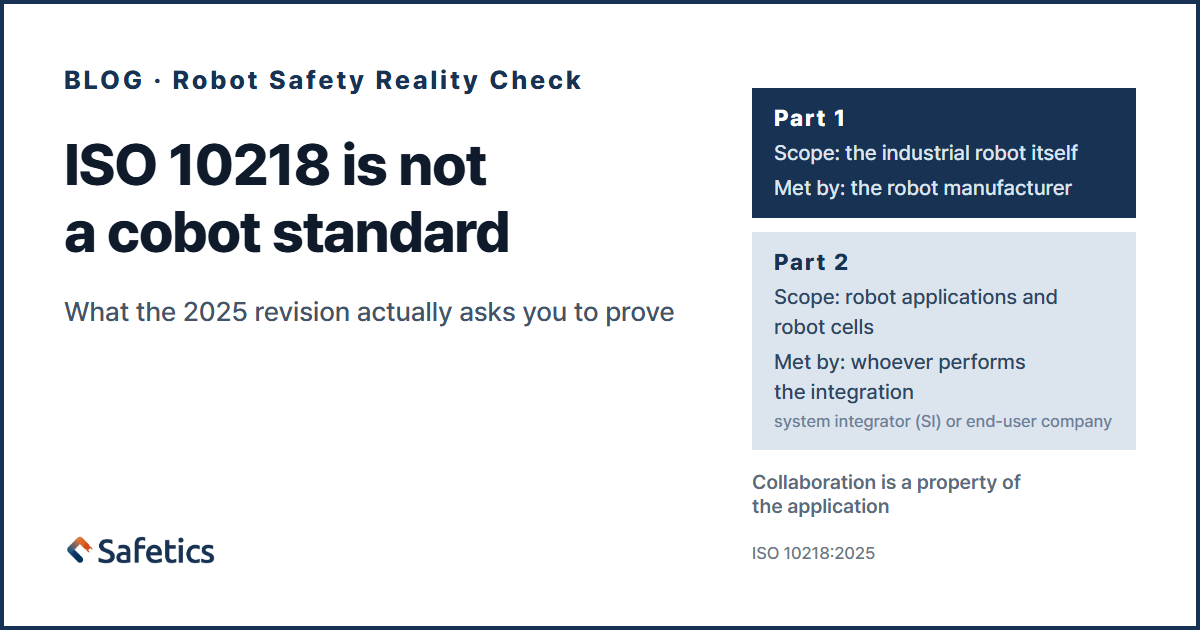
The place this most often goes wrong is the confusion of L1 with L3. A certificate the robot holds is an answer at L1, not at L3. That distinction is also why ISO 10218 is split into Part 1 and Part 2 in the first place, and the structure of the document is covered in ISO 10218 is not a cobot standard.
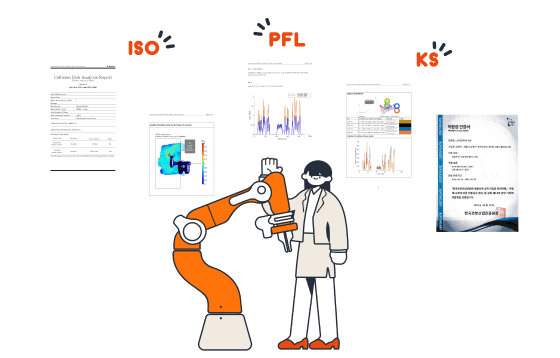
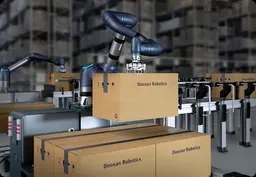
A case in point. A global manufacturer with several plants in Korea introduced a high-payload collaborative robot for the first time in 2025, into a palletizing process at one of them. The application was configured by combining physical barriers, Speed and Separation Monitoring (SSM) and Power and Force Limiting (PFL). What had to be judged was not the product class of the robot but whether the actual application was safe. Permissible contact was evaluated with the Collision Risk Index, which came back in the 0.7 to 0.9 range against a criterion of 1 or below. Every collaborative application has to confirm that it satisfies permissible-contact limits, whatever the payload. What payload changes is how hard that criterion is to pass — which is exactly why a high-payload application cannot be settled by equipment class or by a certificate, and has to be judged as a configured application.
On that verification the site obtained certification for its collaborative robot installation site, and satisfaction with the process was high enough that expansion to another plant is planned.
What do you prepare first so the same evidence is not built twice?
Build L1 through L3 before you build market paperwork. Invert the order and every new market means new evidence; keep it and each new market only adds a procedure to evidence you already hold.
The hardest of these to produce after the fact is L3, and within it the judgement on configurations that permit contact. Once an application is running it is difficult to measure retroactively, and changing the configuration means judging it again.
How often that judgement actually repeats shows in our own tally. Combining analyses customers ran directly with analyses we performed as a service, the cumulative total is more than 1,000 robots, every one of them a Power and Force Limiting analysis run to decide whether an application can run collaboratively. The results feed three design paths: running the whole zone under PFL; keeping PFL in some zones and mixing in Speed and Separation Monitoring for the rest; or going to SSM throughout, using the computed figures as the basis for separation distances. One question, three routes the answer can take. How the three markets' procedures relate to this stack is set out in full in the 2027 Standards Convergence Report.
💡 Safetics View
Verification is not a cost you pay again in each market. It is an asset that works once per market you enter.
In the era of nationally divided standards, verification was a consumable expense — remade every time a market was added. Now a verification record produced once is reused with nothing changing but where it is submitted. The same risk assessment, the same safety-function verification, the same permissible-contact figures carry straight across. That is not a metaphor. It is a statement about physical documents.
So preparation succeeds or fails less on which market you enter first than on which layer of evidence you secure first. There are three procedures, and one set of answers they all mark against.
Three markets ask for the same technical evidence in three different procedures. The full report sets out what each one requires, and how far the evidence is shared.











.jpg&w=3840&q=100)









.jpg&w=3840&q=100)
.png&w=3840&q=100)

.jpg&w=3840&q=100)